Long before modern baristas steamed plant-based lattes, medieval European cooks relied on almond milk to survive grueling religious fasts. When Church law outlawed dairy products for over a third of the year, wealthy kitchens turned to crushed nuts as an ingenious substitute.
This ancient almond milk history reveals how medieval cooking transformed strict religious abstinence into royal luxury. You can still taste these vibrant culinary traditions across Europe’s historic monastic valleys and southern orchards.
From Mediterranean groves to English castle hearths, grinding almonds provided flavor, thick sauces, and spiritual compliance. Here is why nut milk conquered European tables eight centuries ago.
In This Briefing09 Sections ▾
- 01Highlight #1: The 1226 Baghdad Milestone and Mediterranean Trade
- 02Highlight #2: The Strict Catholic Ban on Medieval Lacticinia
- 03Highlight #3: Mortars, Pestles, and the Rapid Daily Kitchen Grind
- 04Highlight #4: Royal Wardrobe Bills and Northern European Luxury
- 05Highlight #5: Master Cookbooks and the Rise of Almond Sauces
- 06Highlight #6: Butter Indulgences and the Rouen Cathedral Tower
- 07Highlight #7: The Modern Plant Milk Wars and Ancient Roots
- 08Keep the Momentum: How to Plan Your Own Adventure
- 09Frequently Asked Questions
Highlight #1: The 1226 Baghdad Milestone and Mediterranean Trade
In 1226, exactly 800 years ago, scribe Muhammad ibn al-Hasan al-Baghdadi compiled the famed culinary manuscript Kitab al-Tabikh in Baghdad. His collection recorded 160 elaborate court recipes celebrating almond broths, nut pastes, and rich meat stews.
Arabic food culture had already mastered nut emulsions centuries earlier. Culinary pioneers like Ibn Sayyar al-Warraq documented almond waters and oils in tenth-century texts, introducing sophisticated techniques that soon traveled into southern European ports.
Italian merchants brought these prized nuts from the Levant across maritime trade routes into Salerno and Sicily. Twelfth-century medical texts such as the Trotula quickly praised almond emulsions for nourishing wealthy patients and soothing sensitive stomachs.
- Key Manuscript: Kitab al-Tabikh, compiled in Baghdad in 1226.
- Cultural Gateway: Mediterranean trade networks through Salerno and Palermo.
- Historical Role: Bridged Islamic culinary science with Christian European dining.
Highlight #2: The Strict Catholic Ban on Medieval Lacticinia
Medieval Christians observed an exhausting fasting calendar. Beyond the standard forty days of Lent, believers abstained from rich foods during Advent, seasonal Ember Days, and weekly vigils.
Historian Allen Frantzen estimates that twelfth-century laypeople fasted for roughly 150 days each year. Monks spent up to 200 days—over half their lives—under stringent dietary restrictions.
Church doctrine prohibited all meat, eggs, and lacticinia, the Latin term for animal dairy products. Cooks could not touch cow’s milk, sheep’s cheese, or animal butter without committing a serious spiritual offense.
Almond milk provided an authorized, shelf-stable loophole. Because it derived from trees rather than animals, clergy classified it as fasting-safe, making it the ultimate staple for Lent recipes.
- Annual Fasting Load: Between 41% and 54% of the medieval calendar.
- Prohibited Items: Meat, poultry, animal fats, eggs, cheese, and fresh dairy.
- The Solution: Plant-based emulsions that satisfied strict canon law.
Highlight #3: Mortars, Pestles, and the Rapid Daily Kitchen Grind
Popular myths suggest medieval servants spent grueling weeks grinding nuts into liquid. In reality, skilled kitchen staff prepared fresh batches in minutes to a couple of hours.
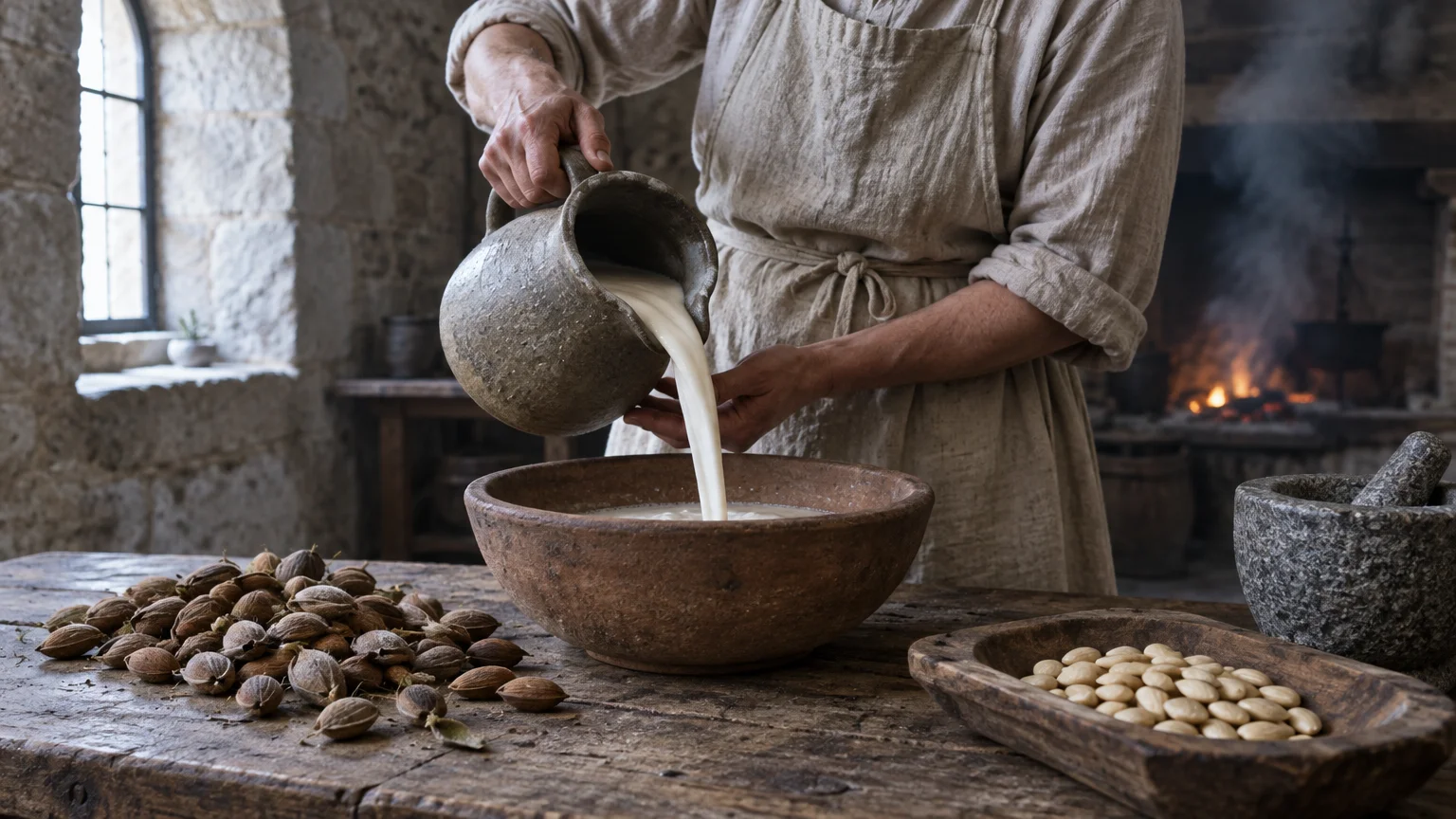
Scullions first blanched whole almonds in boiling water to slip off their fibrous brown skins. Workers then pounded the white kernels inside heavy stone mortars until they formed a smooth, oily paste.
Cooks steeped this paste in warm water or seasoned broth for ten to thirty minutes. Straining the slurry through fine linen cloth yielded a fragrant, creamy fluid ready for immediate simmering.
Unlike raw cow’s milk, which spoiled quickly without refrigeration, dried almonds stored well for months. Kitchens ground only what they needed each morning, ensuring fresh, sweet milk on demand.
- Prep Time: Roughly 30 to 120 minutes per batch.
- Essential Tools: Stone mortar, wooden pestle, and woven linen straining cloths.
- Culinary Advantage: Zero risk of souring compared to raw cow or sheep milk.
Highlight #4: Royal Wardrobe Bills and Northern European Luxury
Almond milk was not peasant sustenance in northern Europe. In chilly England and Germany, where almond trees could not survive frost, imported nuts commanded extraordinary prices.
In 1286, royal household accounts show King Edward I purchased an astonishing 28,500 pounds of almonds alongside 6,600 pounds of rice. Decades earlier, noblewoman Eleanor de Montfort bought 280 pounds at one shilling per five pounds.
By fifteenth-century London, a single pound of almonds cost three times more than a pint of dairy butter. Grinding almond milk served as a dazzling display of aristocratic wealth and conspicuous consumption.
Meanwhile, Mediterranean villagers enjoyed far cheaper access to local harvests across Spain and southern Italy. In the north, however, the drink defined royal feasts and wealthy monastic tables.
- Royal Budget: 28,500 pounds of almonds acquired for King Edward I in 1286.
- Relative Cost: Three times the price of butter in fifteenth-century London.
- Social Geography: Elite luxury in northern castles; everyday produce in the Mediterranean.
Highlight #5: Master Cookbooks and the Rise of Almond Sauces
By the fourteenth century, medieval European cookbooks featured almond milk across hundreds of recipes. Northern Europe’s earliest collection, the early thirteenth-century Libellus de arte coquinaria, placed almond preparations at the core of refined cooking.
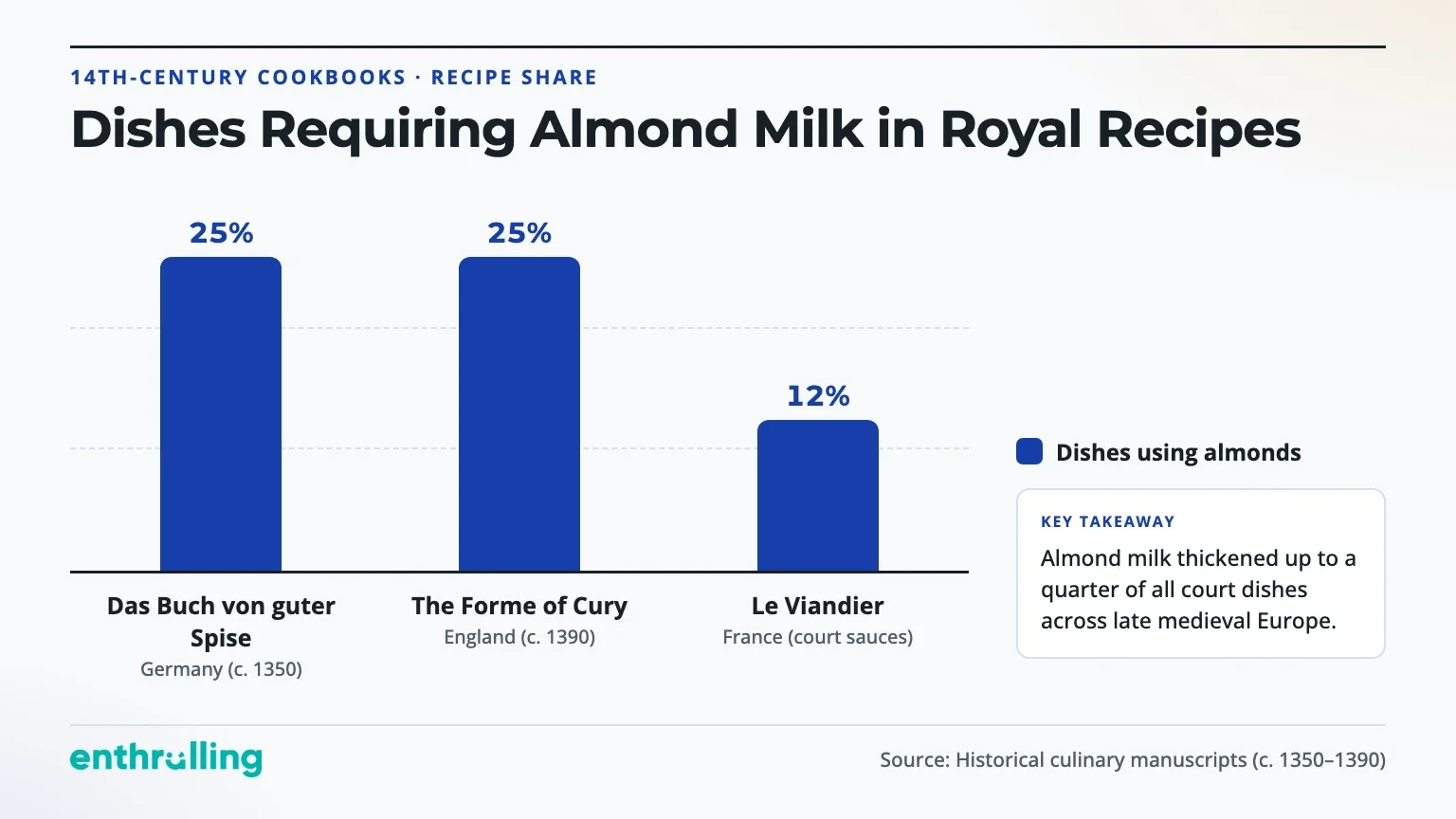
In Germany’s oldest surviving culinary manuscript, Das Buch von guter Spise from around 1350, nearly 25 percent of all dishes require almond milk. German cooks whipped it into puddings and spiced vegetable purees.
England’s master chefs showed equal devotion in The Forme of Cury, compiled around 1390 for King Richard II. Nearly a quarter of its 196 recipes used almonds to bind delicate sauces and poach pike.
French master chef Guillaume Tirel echoed this technique in Le Viandier, where almond emulsions thickened twelve percent of court sauces. Cooks valued the nut liquid because it never curdled over fierce wood fires.
- Das Buch von guter Spise (c. 1350): Nearly 25% of recipes used almond milk.
- The Forme of Cury (c. 1390): Up to 25% of 196 royal recipes called for almonds.
- Le Viandier: Utilized almond emulsions in 12% of French court dishes.

Highlight #6: Butter Indulgences and the Rouen Cathedral Tower
Not every wealthy medieval Christian wanted to drink almond milk throughout Lent. Aristocrats in northern dairy regions missed their beloved cream, cow’s milk, and salted butter.
To satisfy wealthy cravings, the Catholic Church began selling papal dispensations known as butter indulgences. Wealthy French citizens paid six livres tournois to Pope Innocent VIII for the legal right to consume dairy.
These dairy taxes generated vast fortunes for ecclesiastical building projects across France. In Normandy, cathedral administrators pooled these fees between 1488 and 1506 to construct the flamboyant Tour de Beurre at Rouen Cathedral.
The Butter Tower still stands as a magnificent stone monument to dairy cravings. If you could not afford papal exemption fees, however, your kitchen staff kept pounding almonds until Easter morning.
- Location: Rouen Cathedral, Normandy, France.
- Construction Era: Built between 1488 and 1506 through dairy exemption fees.
- Cultural Legacy: Physical proof that fasting rules dramatically shaped European architecture.
Highlight #7: The Modern Plant Milk Wars and Ancient Roots
Modern grocery shelves showcase almond beverages as twenty-first-century innovations. Yet English speakers have applied the word “milk” to plant fluids since at least eleventh-century Old English manuscripts.
The Oxford English Dictionary records the specific term “almande mylk” as early as 1381. Medieval Europeans never confused nut liquids with animal dairy; they simply used the word to describe white, creamy textures.
Today, that vocabulary sparks fierce legal battles. On February 11, 2026, the UK Supreme Court ruled unanimously in Dairy UK Ltd v Oatly AB that plant brands cannot use dairy terms in promotional slogans.
British and European stores now sell cartons labeled as almond drink, while American regulators allow almond milk under FDA guidance. Meanwhile, Eastern Orthodox Christians still rely on nut milk throughout their forty-day Great Lent.
- Market Projection: Global almond milk revenues approaching $7.3 billion in 2026.
- Legal Reality: UK Supreme Court enforced strict dairy label protections in February 2026.
- Living Ritual: Eastern Orthodox Great Lent continues uninterrupted dairy-free fasting traditions.
Keep the Momentum: How to Plan Your Own Adventure
You can recreate authentic medieval almond milk in your own kitchen with historic techniques. Buy whole raw almonds, blanch them in boiling water, and crush them in a heavy stone mortar.
Steep the crushed nut paste in simmering water with cinnamon and rosewater for twenty minutes. Strain the liquid through unbleached cheesecloth for an authentic taste of fourteenth-century English court dining.
Travelers can also trace these culinary roots across Europe by exploring monastic ruins and historic markets. Visit Rouen Cathedral to admire the Butter Tower, then journey south to explore Sicilian almond groves in Agrigento.
Plan your European heritage trips during late winter to experience traditional pre-Lenten festivals and almond blossoms. Always respect local church etiquette and book historic culinary tours well in advance.
Verify travel advisories and guidelines through the European Union travel portal. For cultural research, consult institutions like Lonely Planet and National Geographic.
Disclaimer: Information can change quickly. Confirm opening times, pricing, and safety advisories with official sources before booking or travelling.
Frequently Asked Questions
Did medieval peasants drink almond milk every day?
Peasants in northern Europe rarely tasted almond milk because imported nuts cost far too much. They survived long fasts on pea broths, root vegetables, dark rye bread, and small beer.
How did medieval doctors view almond milk?
Medical scholars classified almond milk as temperate, moistening, and easy to digest. Fifteenth-century physicians regularly prescribed warm almond emulsions to restore frail patients and calm burning fevers.
When did the Catholic Church officially lift the dairy ban?
The Vatican permitted eggs and dairy products during fast days in the 1917 Code of Canon Law. In 1966, Pope Paul VI further reduced mandatory fasting days through his apostolic constitution.
Can you cook with medieval almond milk today?
Homemade medieval almond milk functions wonderfully as a binder for spiced broths, curries, and berry puddings. It remains stable at high temperatures without separating, making it superior to many modern boxed brands.